

Current solution for Long-Term Signal Analysis
Anyone seeking to conduct long-term electromagnetic field measurements or RF signal analyses from an airborne platform quickly encounters a fundamental problem: battery-powered free-flying drones simply cannot stay in the air long enough. With flight times of 20 to 30 minutes, every forced landing creates a gap in the measurement data set, every battery change carries the risk of an orientation error during takeoff, and every restart generates thermal transients in the onboard electronics that can distort sensitive RF measurements. Over the course of a full-day measurement campaign, these interruptions not only disrupt workflow—they jeopardize the scientific integrity of the entire dataset.
Why Tethered Systems Are the Right Choice for Long-Term Signal Analysis
A tether system solves this problem at its root. The continuous power supply from the ground keeps the platform in the air without interruption and eliminates battery cycles along with the associated attitude errors. The cable also solves a less obvious but equally serious problem: wireless telemetry from a free-flying drone is itself an RF emitter that contaminates the spectrum being measured. Data transmission via a fiber-optic cable completely eliminates this source of interference and keeps the measurement environment clean. The same principle applies to positional accuracy. Free-flying drones drift in the wind and rely on GPS stabilization, which under normal conditions results in positional errors of more than one meter—unacceptable for antenna pattern verification, coverage mapping, or regulatory compliance testing. A mechanically fixed tethered platform ensures spatial repeatability, which is what makes measurement series comparable in the first place.
Regulatory Advantage
In many countries, tethered drone systems fall into a more favorable legal category and allow for continuous operations that simply could not be approved for free-flying drones. Uninterrupted power supply, interference-free data transmission, positional accuracy, and regulatory manageability—together, these factors make tethered drones not only a strong option for serious long-term signal analysis, but the only one capable of reliably delivering the required data quality.
Accurate data thanks to an unlimited supply
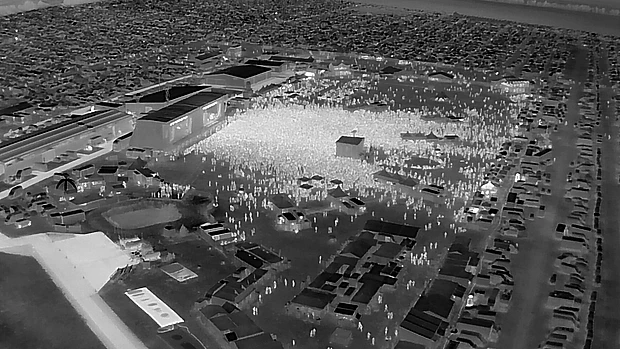
Thanks to an unlimited flight time, data can be transmitted continuously for hours or even days without any gaps in the recordings. The fiber-optic connection also enables clean data transmission without interference from UAS telemetry or other sources.
Stable in the recording
Without repeated restarts, the onboard electronics remain thermally stable throughout the entire deployment. Sensitive RF sensors deliver consistent, drift-free readings from the first minute to the last. Mechanical grounding keeps the drone within a precisely defined measurement volume, regardless of wind or gusts. This spatial repeatability is essential for comparing measurements across multiple sessions or time periods.
Cost Efficiency
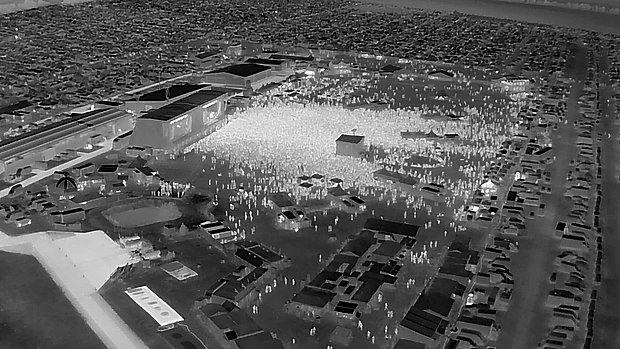
Eliminating battery logistics, reducing operator intervention, and avoiding repeated setup cycles significantly lowers the operational cost of long-term measurement campaigns.