
VALOFLY Supports the ROCKHARZ Festival in Evaluating its Visitor Arrival Concept
The ROCKHARZ Festival, VALOFLY GmbH and CiS GmbH have jointly evaluated the new arrival concept, which, in conjunction with the revised site plan, is intended to help manage traffic flows in order to reduce previous arrival congestion. In previous years, the increasing popularity of the ROCKHARZ Festival, the growing number of visitors, and, above all, the desire to arrive early have caused significant traffic congestion in the surrounding area.
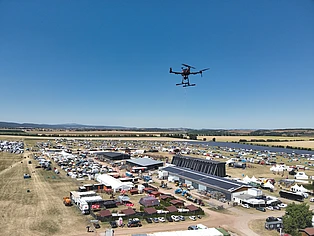
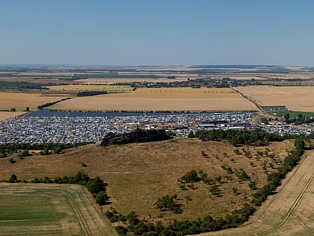
The aim of the flight was to analyze the number of parked cars per time interval. The focus was particularly laid on areas not reserved by visitors. Visitors arrive and park in the first available space on the campsite that is assigned to them on site. The entire arrival day was not only recorded for analysis, but also made available to the respective responsible persons via livestream. It was important that no license plates were recorded and no individuals could be identified.
The feedback from the ROCKHARZ team was positive across the board. “I kept checking the livestream in between other tasks, so I could work on other stuff while still keeping an eye on the most important topic of the day, no matter where I was on the festival grounds,” one of the organizers later summed up.
The VALOFLY team was once again responsible for the aerial photo of the year. Since the festival has been held in Ballenstedt in the Harz Mountains, all visitors can take home a free poster with the aerial photo at the end of the festival. As the airfield's runway is now also used as a parking lot, the aerial photo can no longer be taken from an airplane. VALOFLY has now taken the photo by drone for the third year in a row.

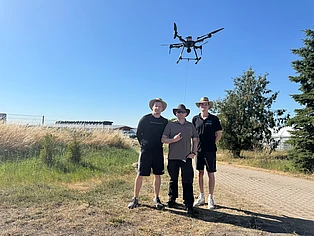
The idea to document our arrival concept in this way came at quite short notice. Observing the whole arrival from the air is actually quite obvious. The VALOFLY team knows our site and has a good relationship with the operator of Ballenstedt airfield, which meant that legal issues could be taken into account right away. Since the drone was constantly in the air, we had no interruption in the data and, even better, we were able to react to many things in real time, for example when visitors suddenly set up their tents in a place where they weren't supposed to be. So, in addition to the actual evaluation, there was an additional benefit.